Biomass starts in the forest.

Small‑scale wood‑gasification CHP for Japan's forests

Analema develops containerized wood-gasification CHP plants in Japan — designed to run on local forestry thinnings and sawmill residues — and is built to operate them long-term.

Analema GK is an authorized partner of LiPRO Energy for Japan.

The market, mapped

184 certified small-scale biomass projects in Japan have not yet started operating. 63 of them (79.1 MW) have been stalled for four years or more. Analema works to take these projects over and build them.

712
Projects mapped
475.4 MW
528
Operating
325.7 MW
121
Certified <4y
70.6 MW
63
Stalled 4y+
79.1 MW
Map loads as you scroll…

Where the stalled capacity sits

PrefectureStalled (4y+)Stalled MW
Gunma713.5 MW
Mie64.2 MW
Miyazaki64.4 MW
Shizuoka58.5 MW
Hyogo34.8 MW
Explore the full map

Japanese Forest Management, Thinning, and Cascade Wood Use

How Japanese planted forests are thinned and harvested, how logs are graded, and which low-grade wood, bark and offcuts go to energy.

A forest is a long infrastructure cycle

Biomass starts decades before fuel arrives.

Japan's planted forests need active management over a cycle of roughly 40–70 years, depending on species and site. Below is how a managed forest works, stage by stage. Wood goes to energy only after its higher-value uses.

YEARS 0–5

Planting & grass cutting

Seedlings are planted across the cleared ground, then the grass and weeds around each sapling are cut back every summer. Clearing that competition lets light reach the young trees so they survive their most vulnerable years.
YEARS 6–40

Five-year thinning cycles

Every five years or so, selected trees are cut and removed. Giving the best trees more light and root space makes the remaining stand stronger — and these thinnings are the first usable material the forest yields.

YEARS 40–60+

Larger harvest cycles

As growth slows, the trees reach maturity and the main harvest begins. Logs are brought to the landing and sorted by grade, so each piece goes to its highest-value use.

PROCESSING

Processing

Good sawlogs become lumber for homes and furniture, and the rest cascades down through panels and paper. Only bark, offcuts, and low-grade material no higher-value market can use go to energy.

REPLANTING

Replanting

Within a few seasons the harvested ground is replanted with new seedlings. The cycle begins again, and the forest carries on as renewable infrastructure.

LiPRO Containerized Wood-Gasification CHP

LiPRO containerized wood-gasification CHP: 100 kWe and 232 kWth per unit on 1.64 t/day of bone-dry wood chips. Specs, fuel and grid connection.

100kWe
Electrical output
Manufacturer-confirmed rating. The published legacy datasheet lists 85 kWe / 198 kWth per unit.
232kWth
Thermal output
Manufacturer-confirmed rating, recovered from the syngas cooler, the engine jacket, and exhaust-gas recovery.
1.64t/day
Fuel consumption
Bone-dry basis, per unit, on the confirmed 100 kWe / 232 kWth output; roughly 3.29 t/day as delivered at ~50% green moisture.
~8,000h/yr
Target operating profile
~30m²
Footprint

Reference design — 3× HKW300 cascade

Analema's reference design is three LiPRO HKW300 wood-gasification CHP units run in cascade, paired with CFD belt drying, in a containerized Mobile Cube format. The figures on this page are design figures for this configuration — not measurements from an operating plant.

300kWe
Cascade electrical output (design)
~696kWth
Cascade thermal output (design)
~2,400MWh-e/yr
Annual electrical output (design)
≈4.8t/day
Cascade fuel consumption (design)

What Analema does

From forest supply contract to operating plant, we develop the whole chain.

Analema develops containerized wood-gasification CHP plants designed to run on the low-grade side of this exact forest cycle — the thinnings, bark, and offcuts no higher-value market claims — and is built to operate them long-term. Around that core we work across the chain, from forest contract to operating plant, supporting the partners each stage depends on.

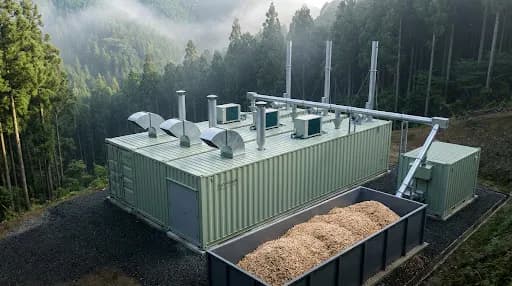
Aerial view of the reference site: three joined containerized units, dryer, and walled chip bay (concept rendering based on the manufacturer layout)
Concept rendering based on the manufacturer layout
  • Land identification & assessment

    Identifying candidate sites and assessing them against forestry catchment, access, and site conditions before a project is defined.

  • Fuel-chain development

    Building durable local supply relationships with forestry suppliers, thinning operators, and sawmills so fuel is secured by multi-year contracts.

  • Utility & regulatory coordination

    Managing grid interconnection, permitting, and the local regulatory steps a forestry-fed biomass project needs to move forward.

  • EPC & commissioning

    Coordinating engineering, procurement, and construction of the CHP unit and site infrastructure, through to startup and commissioning.

  • Technology integration

    Matching the CHP system to the site's actual fuel and its heat and power demand.

  • Long-term operations support

    Ongoing monitoring, maintenance coordination, and performance support after commissioning, sized for a low-staffing, remotely monitored unit.

Start the conversation

Discuss a forestry-first biomass project.

Tell us who you are and what you're working on. We read every inquiry and reply within 3 business days.

Prefer email? info@analema.xyz·Fukuoka, Japan

Tell us who you are

Inquiry type