Forestry & Biomass
Japanese Forest Management, Thinning, and Cascade Wood Use
Learn how managed Japanese forests, selective thinning, stockyard sorting, sawmill residues, and cascade use create the foundation for responsible biomass.
A 60–70 year forest cycle
Japan's post-war planted forests of sugi and hinoki are now reaching maturity after six to seven decades of growth. Decisions made across that whole cycle — spacing, thinning timing, harvest planning — determine whether a stand grows into healthy, valuable timber or into an overcrowded liability. Biomass only exists downstream of decades of forestry work; it does not start at the power plant.
Managed vs. unmanaged forests
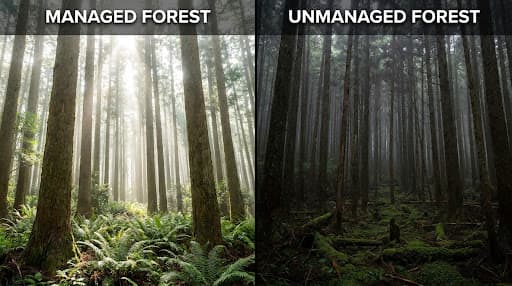
A thinned, managed forest lets sunlight reach the forest floor, which strengthens root systems and understory growth. An unmanaged, overcrowded stand can become dark, thin-rooted, and more vulnerable to storm damage, disease, and slope risk. Regular thinning supports slope stability by encouraging deeper, more distributed root systems — it does not guarantee against every hazard, but it measurably improves a stand's condition.
Selective thinning, not clear-cutting
Thinning removes a portion of a stand — the weakest, most crowded, or poorly formed trees — so the remaining trees have room to grow. It is carried out with chainsaw crews, winches, compact harvesters and processors, and forwarders working on steep terrain and narrow forest roads. The stand is never cleared; it is cared for.
Cascade use: high-value wood first
Wood recovered from thinning and harvest does not move straight to a power plant. Good logs are graded for construction lumber, furniture, panels, and paper — the highest-value uses available. Biomass is the last and smallest stream in the cascade: thinnings, small-diameter logs, bark, branches, and offcuts that have no higher-value market. High-value wood first. Biomass last.
- Planted forest (森林) — decades of managed growth.
- Selective thinning (間伐) — the weakest and most crowded trees are removed.
- Roadside sort by grade (選別) — logs are separated by quality and route.
- High-value stream — sawlogs go to construction, furniture, panels, and paper first.
- Low-grade stream — only thinnings, bark, branches, and offcuts continue as fuel.
- Gasification CHP (熱電併給) — the fuel-tolerant unit converts low-grade material.
- Heat and power (供給) — thermal and electrical output serve local use.
- Revenue and jobs (循環) — value returns to fund ongoing forest maintenance.
Sawmill residues and the fuel stream
Sawmills that process graded logs into lumber also generate bark, chips, sawdust, and offcuts as a normal part of production. Instead of becoming waste, these residues can feed a local biomass fuel stream, giving sawmills an additional use for material they already produce.
Why forestry-first matters
Thinning (間伐) is forest maintenance, not clear-cutting (皆伐) — the two are not the same practice and should not be confused. Biomass does not compete with timber, furniture, or paper markets: it is positioned deliberately at the bottom of the cascade, using material those markets cannot use. That ordering is what makes the model forestry-first rather than fuel-first.
Common questions
Is thinning (間伐) the same as clear-cutting (皆伐)?
No. Thinning removes a portion of a stand — the weakest, most crowded, or poorly formed trees — so the remaining trees have room to grow. The stand is never cleared; it is cared for. Clear-cutting is a different practice, and the two should not be confused.
Does biomass compete with the timber, furniture, or paper markets?
No. Good logs are graded for construction lumber, furniture, panels, and paper first — the highest-value uses available. Biomass is the last and smallest stream in the cascade, using only material that has no higher-value market.
What wood becomes biomass fuel?
Thinnings, small-diameter logs, bark, branches, and offcuts that have no higher-value use, along with sawmill residues such as bark, chips, sawdust, and offcuts generated during lumber production.
Does thinning reduce forest disaster risk?
Regular thinning supports slope stability by encouraging deeper, more distributed root systems. It does not guarantee against every hazard, but it measurably improves a stand's condition compared with an unmanaged, overcrowded stand.