For municipalities
Turn the forest environment transfer tax into a visible result
Analema turns a municipality's dormant forest environment transfer tax (森林環境譲与税) into a visible thinning-to-wood-to-local-heat result: forestry-first combined heat and power (熱電併給) that discharges the Forest Management obligation, aligns with the regional biomass ecosystem, and creates local jobs.
The forest environment transfer tax, made visible
The forest environment transfer tax (森林環境譲与税) is a valuable source of funds — but nationally, much of it sits unspent in reserve. The Board of Audit's sample review (as of the end of FY2023) reported 37.7% still unexecuted, with most municipalities having drawn up no plan to spend it. We turn that fund into a result a resident can see: thinning → wood recovered → local combined heat and power (熱電併給), delivered as one continuous chain your office can point to.
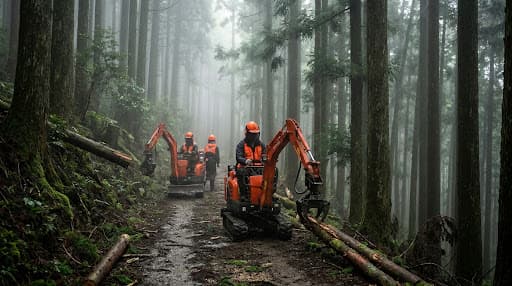
Discharging the Forest Management obligation — and what comes after
Under the Forest Management and Administration system (森林経営管理制度), in force since 2019, your municipality takes on under-managed private forest. We take on the part that usually stalls after the ownership-intent survey: the people to do the maintenance and the outlet for the wood. Rather than adding work to a short-staffed desk, we act as the external engine that keeps the obligation moving.
Aligned with the regional biomass ecosystem
Forestry-first, locally-consumed combined heat and power is exactly the form the Forestry Agency's regional biomass ecosystem (地域内エコシステム) is designed to promote. Built to meet the regional-use requirement (地域活用要件) as small-scale, locally-consumed supply, it circulates local unused material within the region — the opposite of the large, import-fuelled plants now retreating from both policy and market.
Local jobs and the next generation of forestry
Material production, chipping, and plant operation put work back into the community — squarely within the tax's mandated uses of maintenance, workforce development, and wood-use promotion. A steady outlet for thinned wood is what lets thinning continue year after year instead of stopping when the survey ends.
District heat for public facilities — an ESCO model
Heat for hot-spring facilities, pools, schools, and civic buildings can be delivered on an ESCO (shared-savings) model, holding down the municipality's up-front cost while replacing utility fuel with heat from local material. Tsushima City's woody-heat supply to a managed bathing-and-pool facility is a close precedent for how this works in practice.
A contribution to disaster resilience
A well-maintained forest supports slope stability by encouraging deeper, more distributed root systems. It does not prevent every hazard — we are careful not to claim that — but clearing neglected plantations measurably improves a stand's condition and contributes to lowering disaster risk. A local, distributed heat-and-power source also strengthens energy resilience against supply disruption.
The biomass map as policy evidence
Private data can make visible the problems administration tends to overlook. Our biomass map shows, prefecture by prefecture, the certified-but-not-operating projects and the scale of stranded capacity — a ready foundation for prioritising surveys and maintenance plans, and the single asset that most sets Analema apart.
One block, at the scale of a town
The unit behind every figure
One block, on your land
Three LiPRO HKW300 units run in cascade, one CFD dryer, and one moving-floor fuel bay.
Reference configuration — design figures from the manufacturer specification and our published model, not measurements from an operating plant. No project is sited or in progress. This three-unit reference block is a distinct configuration from the ten-unit data-center block.
One block runs on roughly 360–600 ha of managed forest under a 50-year rotation, at a sustainable thinning yield of 6–10 t-wet/ha/yr — town-scale, and smaller than a typical ownership-intent survey area. The demand it creates is what pulls a few hundred hectares a year into the survey-maintenance-harvest cycle, year after year.

The honest structure — stated as a feature
The forest environment transfer tax (森林環境譲与税) funds the fuel chain: thinning, workforce development, and wood-use promotion — its own eligible uses. The plant itself is always our capital, on a BOO/ESCO basis. There is no precedent for transfer-tax-funded plant capital, and we do not pretend otherwise — that line is exactly what a section chief can defend upstairs.
Illustrative — precedents, pending primary-source checks
The path follows municipal practice: sounding-type market survey → covenant (協定) → build.
Figures are illustrative and precedent figures are secondary-source until a primary-document check; we bring your own numbers to the sounding.
Common questions
How does this help us spend the forest environment transfer tax?
We turn the fund into a visible chain — thinning, wood recovery, and local combined heat and power (熱電併給) — that your office can present to residents as a concrete maintenance result, addressing the unexecuted-balance disclosure the national government now requires.
Does this add work to our forestry desk?
No. We act as the external engine that takes on the maintenance workforce and the wood outlet after the ownership-intent survey — the part that usually stalls — so the Forest Management obligation (森林経営管理制度) keeps moving without more load on your staff.
How do we start?
With a conversation — a sounding-type market survey or an exchange of views — not an online application. Reach us by form or email, addressed to your forestry or agriculture-and-forestry section.
What happens if Analema withdraws or cannot continue?
The ESCO contract carries step-in and site-restoration provisions, and because the plant is Analema's asset, its removal is Analema's obligation, not the municipality's. The fuel chain built with the forest environment transfer tax — thinning, workforce, and access roads — remains the community's asset. Contract terms, including exit and assignment, are stated up front, so a section chief can defend the arrangement upstairs.
Not an online purchase — we start with a conversation (a sounding-type market survey or an exchange of views). Reach us by form or email.